Key Ideas

How ‘Non-voting’ Begins

The Right Question Project has been working in low-income communities around the country for more than 15 years.

We have often seen how many of the people with whom we work are directly and profoundly affected by decisions made at their children’s schools, at the welfare office, at the housing authority, the job training program, Medicaid-funded health care service.

Tens of millions of citizens in low-income communities come face to face with public agencies all the time. On a national scale, they have nearly a hundred million encounters a year with public agencies.

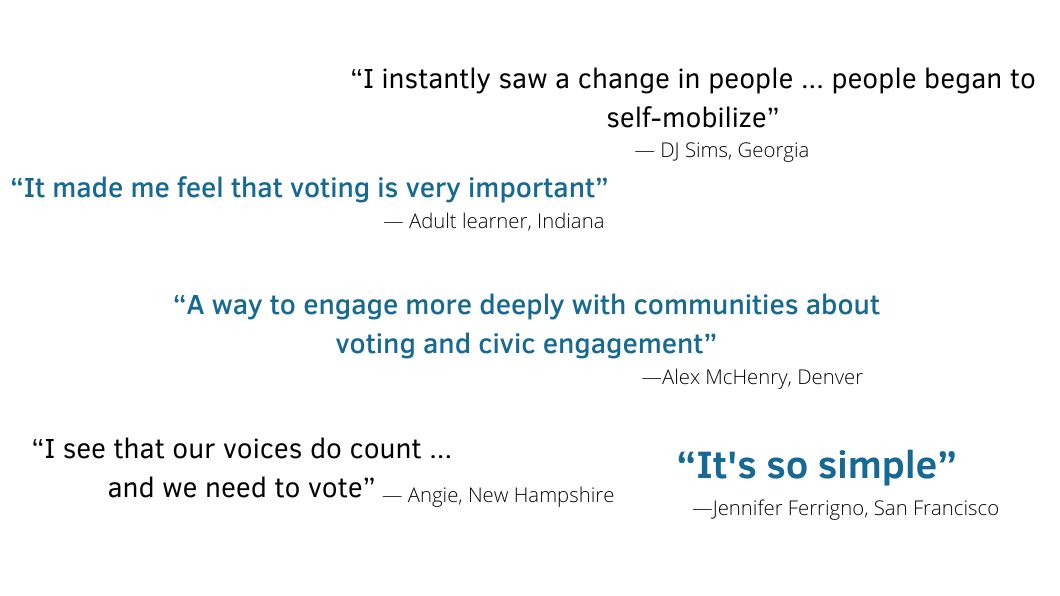
Often, they do not participate in those decisions or at least are not participating effectively. Angie, a welfare client in New Hampshire, told us about how when she is at a place like the welfare office, that’s where I feel like my voice doesn’t count. If people like Angie are not participating in decisions on a “micro” level, in their ordinary encounters with agencies that shape their daily lives, they are probably not going to be participating in other decisions in the public arena, including the occasional election.

Too many voter mobilization efforts skip right over that fact and just try to push non-voters to show up at a polling station once every year or two or four.

The people who are not participating in decisions on a “micro” level, in their ordinary encounters with agencies that shape their daily lives, are probably not going to be participating in other decisions in the public arena, including an occasional election.

Fears of Voting

In our pilot voter education workshops in New Hampshire and Arizona in 2004, participants asked questions about the actual mechanics of voting. Their questions raised issues that have recently been brought before the Supreme Court and offer insights to what’s on their mind as they even consider voting for the first time:

Their questions included (as they wrote them):

  • Can any-one vote?
  • How many chances do we have?
  • What do you need to vote?
  • Will there be security?
  • Do you have I.D.? what kind of I.D?
  • Were are the locate, and if we have some help for information?
  • Can I bring my children with me?
  • What if I can’t get off work?
  • If I’m working in that time, how am I going to vote?
  • Do I have to register in order to vote?
  • Can we vote here in the classroom?
  • What is the day of the election?

Then, towards the end, these questions came up:

  • What if I don’t know what to do?
  • What if I make a mistake?
  • Will I get punished if I do it wrong?

These questions offer a rare glimpse of concerns that are so rarely articulated in public by non-voters. Many of the participants in the workshops have had negative experiences with forms, requirements and even tests of what they know or are told they should know about how systems and institutions function. They have, for the most part, consistently come up short in their encounters with the welfare office, in the employment bureau, at their children’s schools, in their own school experiences. Voting for them means filling out more forms, making another request in order to register, standing alone opposite a government official who has knowledge they do not possess. It means standing alone inside of a voting booth facing yet another sheet that has to be filled out in a certain way, wary of making a mistake, of forfeiting their vote, of ‘messing up.” It means figuring out where to go, how to get there, what to do with their kids, how to fit it around a work schedule that treats election day no differently than any other work day.

In a widely cited study by the Kettering Foundation about why people did not vote in the 2000 presidential election, the top ten list of reasons checked off includes “too busy,” (the top ranked reason), “not interested,” “didn’t like the candidates” and “forgot.” Nowhere on the Kettering Foundation list is a clear echo of the questions raised by the adult education students in our workshops. Their questions reveal how they see voting as an intimidating, unaccommodating, unfamiliar act that is linked to their other encounters with public institutions. It is not a matter of completing a simple task that they just plumb forgot.

Their very legitimate concerns deserve more respect. We must invest in their ability to think and act on their own behalf. We should use voter education efforts to not only expand the electorate, but also to build a citizenry better prepared to participate in decisions and to hold accountable decision-makers on all levels of our democracy.

Kindling Interest, Building Confidence

Our 2004 Voter Engagement Initiative that we piloted in New Hampshire and Arizona produced dramatic changes in traditional non-voters. As they gained new skills and made new connections to the value of voting, they:

  • Motivated themselves to vote
  • Raised their expectations for accountable decision-making
  • Felt they were now far more likely to vote, and, most importantly, far more confident that they were capable of voting

Visit our Research page to read about current research about our Voter Engagement Initiative.

Microdemocracy

The RQP Voter Engagement Strategy for Election Day and Beyond is based on RQP’s idea that people can learn skills and take the first steps of democratic action in their regular encounters with public agencies. RQP has coined a new term – Microdemocracy - to describe individuals using essential democratic skills to participate in decisions in their interactions with public agencies.

Similar to how microcredit makes the case for investing in people outside of the economic mainstream, Microdemocracy makes the argument for investing in people who are currently outside the democratic mainstream.